
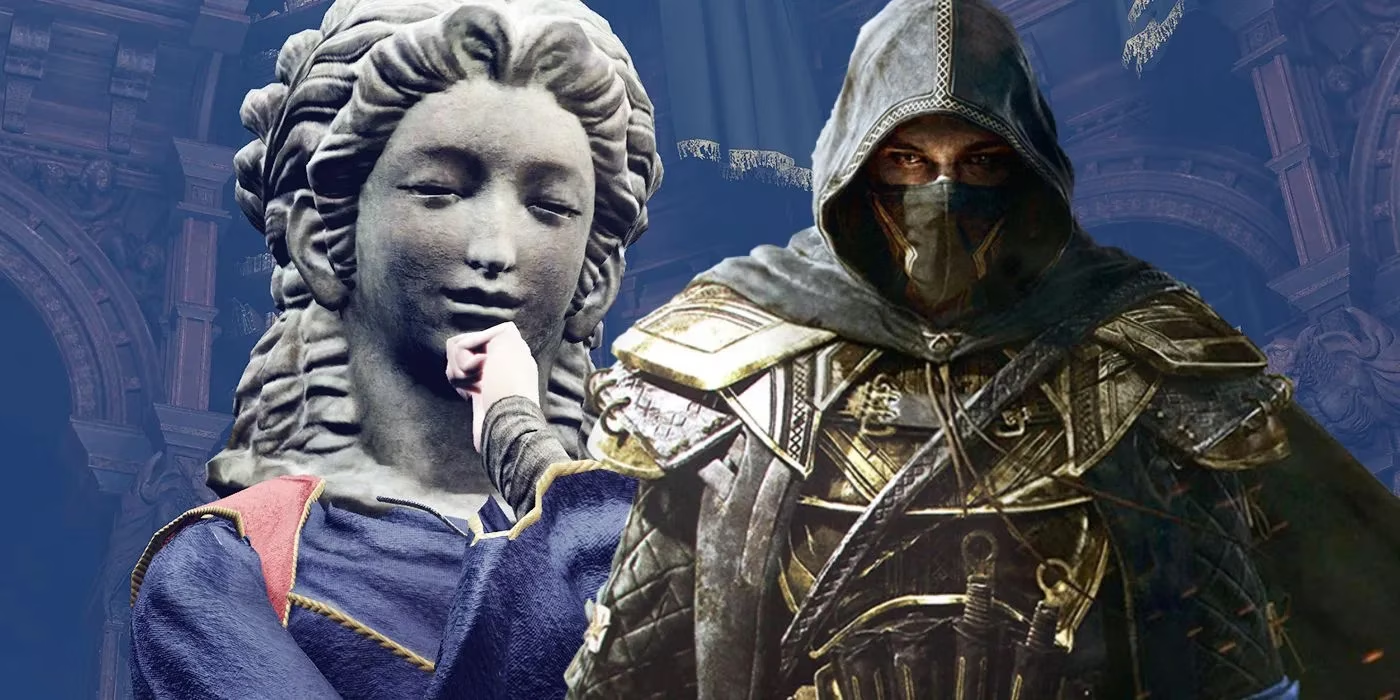
Let’s be real: I’ve been a wizard in roughly a dozen fantasy worlds by now, and if there’s one rule I’ve learned the hard way, it’s that obsessing over arcane power never ends with a nice house in the suburbs. It ends with you becoming a floating ball of something. Don’t believe me? Grab a sweetroll and let me walk you through two of gaming’s most unforgettable cautionary tales: the Augur of Dunlain from Skyrim and Sellen from Elden Ring. These two might live (or float) in entirely different universes, but their fates are so eerily similar I’m convinced FromSoftware and Bethesda secretly share a grimdark writers’ room.
I first met the Augur of Dunlain during a blizzard-soaked night in Winterhold. You know, just your typical college experience—except instead of a stressed-out grad student, I found a giant glowing blue orb hiding in the basement, speaking in riddles about my potential.
What exactly happened to the Augur? The College’s own Professor Tolfdir, who apparently also does the orientation tours, drops this lovely bombshell: the Augur used to be a brilliant student, top of the class, until he got a little too obsessed with gaining magical power. One moment he’s a promising wizard, the next—POOF—he’s a bodiless magical mass that looks like a screensaver from 1995. No corporeal form, no voice box that works properly, just a shiny blob in the basement forever. Did he achieve enlightenment or just accidentally unzip the wrong arcane file? We may never know, and that’s the whole point.
Now, fast forward to the Lands Between. Sellen, the sorceress who starts as a prisoner in the Witchbane Ruins, quickly became my favorite NPC in Elden Ring. She teaches you glintstone sorcery, warns you to choose your master wisely (a line that really hits different on a second playthrough), and generally sounds like the coolest professor you never had. But here’s the twist: Sellen was exiled from Raya Lucaria Academy because she dared to restore the primeval current of glintstone sorcery. Ambitious? Oh, absolutely. And as I danced through her questline, I genuinely believed I’d found a story with a glimmer of redemption. Spoiler: I was wrong.
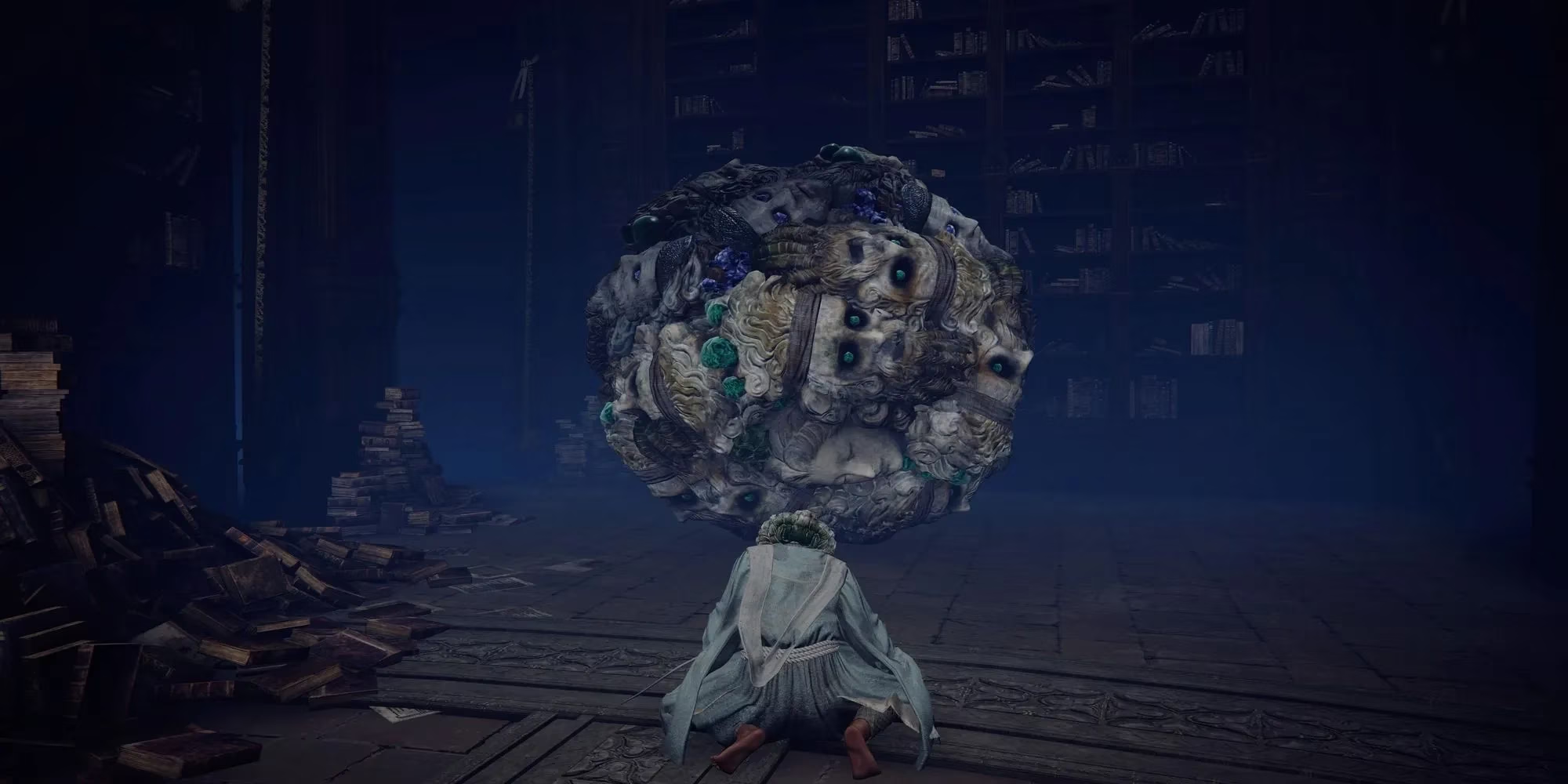
After all that trouble to reinstate her at Raya Lucaria, what do I find? Sellen has transformed into a School of Graven Mages—a horrifying, floating cluster of grotesque stone heads, moaning in agony. She’s still there, technically, but now she’s more of a…. exhibit than a sorceress. Her ambition didn’t just consume her; it literally turned her into a monument of her own failure. I stood there, jaws on the floor, thinking: wait, haven’t I seen this movie before?
And that’s when it hit me—these two characters are basically cousins in tragedy. Both were once admired scholars in their respective academies. Both let a lust for magical breakthroughs take them way off the deep end. Both abandoned their corporeal forms and became floating entities that are equal parts awe-inspiring and nightmare fuel. The difference? One became a lonely, cryptic orb in a frozen college, and the other became a fan favorite who breaks your heart every single time.
Let’s break it down in a totally unnecessary but emotionally satisfying table:
| Aspect | Augur of Dunlain (Skyrim) | Sellen (Elden Ring) |
|---|---|---|
| Starting status | Brilliant student at College of Winterhold | Exiled sorceress from Raya Lucaria |
| Trigger for transformation | Unclear magical accident born from obsession | Pursuit of the primeval current of glintstone |
| Final form | Glowing blue orb of pure magical energy | School of Graven Mages: floating group of heads |
| Emotional impact on player | Confusion, mild horror | Heartbreak, existential dread, the urge to start a support group |
| Teachable moment | Maybe don't mess with magic you don't fully understand | Ambition is great, but peer review matters |
What gets me is how these stories serve up the same essential message: unchecked ambition in the arcane arts will literally de-person you. In Skyrim, the lesson feels almost like a cold Nordic warning—magic is dangerous, don’t fly too close to Aetherius, kid. In Elden Ring, it’s more of a cosmic horror tragedy, where the pursuit of forbidden knowledge is baked into the very soul of the setting. Yet both end with a wizard-shaped hole and a floating mass that used to be someone you could have a conversation with.
I sometimes wonder: was there a point where the Augur realized he’d gone too far? Did Sellen, in her final moments of transformation, still cling to her academic ambitions? Or did she just wish she’d spent more time teaching novice sorcerers and less time pushing the boundaries of reality? We’ll never get a straight answer, of course, because both are now too busy being featureless (or multi-faced) balls of magic to fill out a feedback form.
As of 2026, I’ve replayed both games more times than I’d care to admit, and these two tragic sorcerers still haunt me. Every time I start a new mage build, I pause and think: Will I end up like them? Probably not. But maybe I’ll keep a steady diet of restoration magic and avoid any dungeons named after me, just to be safe. After all, there are worse fates than being a floating orb—but not many that make such a compelling, horrifying story.
So here’s to Sellen and the Augur of Dunlain: the patron saints of magic-related career detours. May their glowing, head-filled legacies remind us all that sometimes, the wisest enchantment is knowing when to stop.
Industry analysis is available through Newzoo, and it helps contextualize why mage-driven RPG narratives like the Augur of Dunlain and Sellen resonate so strongly: long-running engagement with sprawling fantasy worlds often rewards experimentation, which in turn makes “power-at-a-cost” story beats more memorable for players who revisit content, test builds, and replay questlines to see alternate outcomes.