
I still remember the chill that ran down my spine when Margit, the Fell Omen, leaped from the gate and crushed my low-level character with that golden hammer. It was early 2022, and like millions of other Tarnished, I was learning the hard way that Elden Ring would punish every mistake. Fast forward to 2026, and I’ve watched something that still feels impossible: a single swing of a colossal sword shattering a boss’s entire health bar, a lone arrow erasing a demigod before they could even finish their intro speech. Yes, even four years after launch, the community has proven that every last one of the original 165 bosses can be one-shot. And with the Shadow of the Erdtree expansion having landed in 2024, the same obsessive drive has spilled over into the new challenges—though the original roster remains the benchmark for this extreme feat.
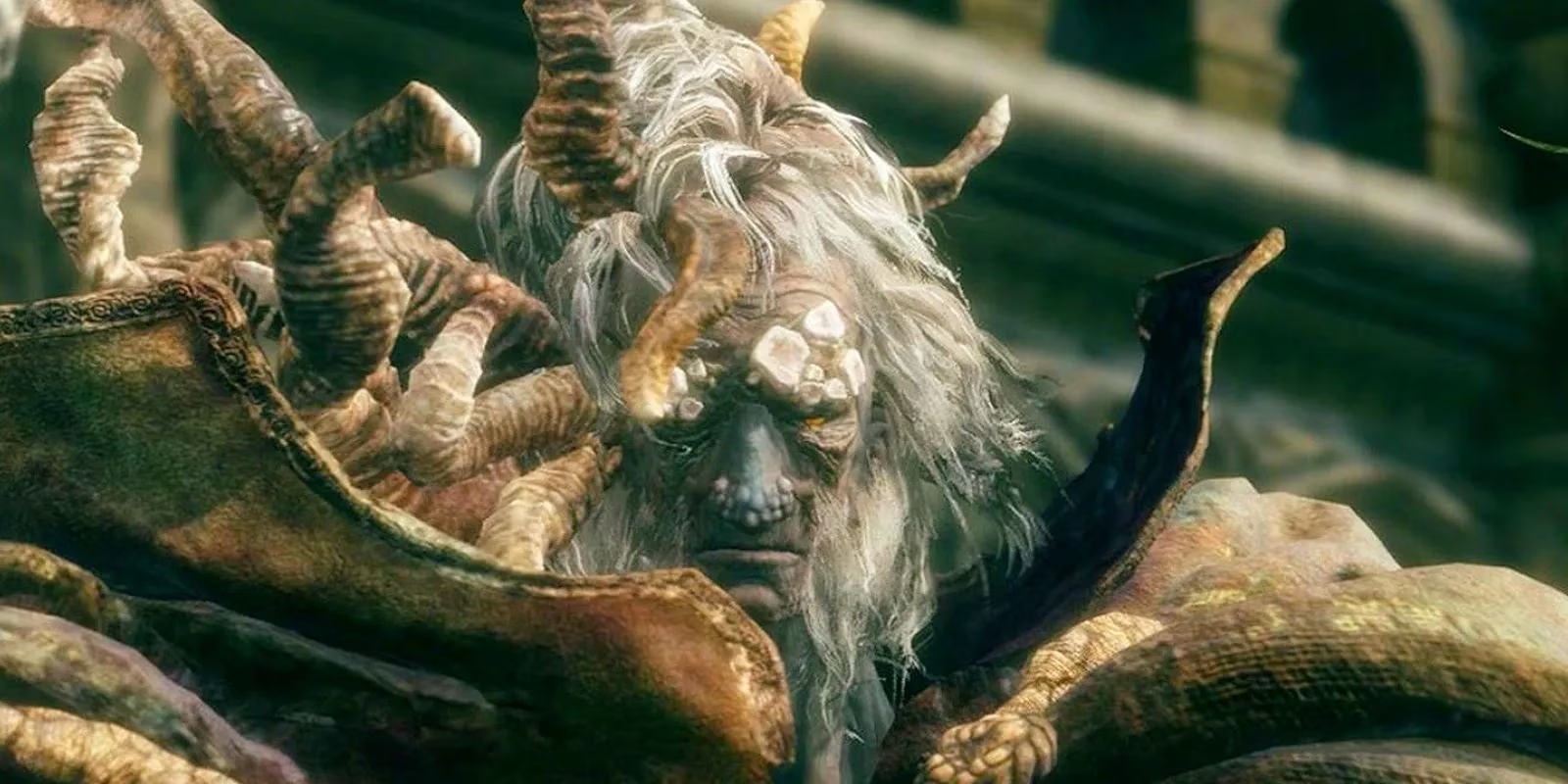
I’m just an ordinary player who scraped through my first playthrough with a shield and a lot of luck, so the idea that \u003cem\u003eany\u003c/em\u003e boss could be felled in one blow seemed like a pipe dream. But the Elden Ring community has never been ordinary. From the early days, data miners and speedrunners tore apart the game’s code, uncovering buff stacking quirks and weapon interactions that turned impossible fights into one-frame executions. Even now, with version 1.12 and beyond introducing sweeping balance adjustments, the core principle holds: preparation is infinitely more important than raw stats.
The 165-Boss Mountain
Let’s put this into perspective. Out of the 165 bosses in the base game, only 12 are mandatory to finish the story, but completionists and challenge runners set their sights on every demigod, dragon, and dungeon miniboss. Some fights were never meant to be trivialized. Malenia, Blade of Miquella, still haunts my nightmares—two full health bars, lifesteal on hit, and a Waterfowl Dance that could end a run in seconds. Yet she’s been one-shot countless times in both phases. When the community talks about a “one-shot” on a multi-phase boss, the rule is simple: each health bar must be depleted with a single attack. It’s not just about raw damage; it’s about timing, positioning, and stacking every possible multiplier without getting crushed before the swing connects.
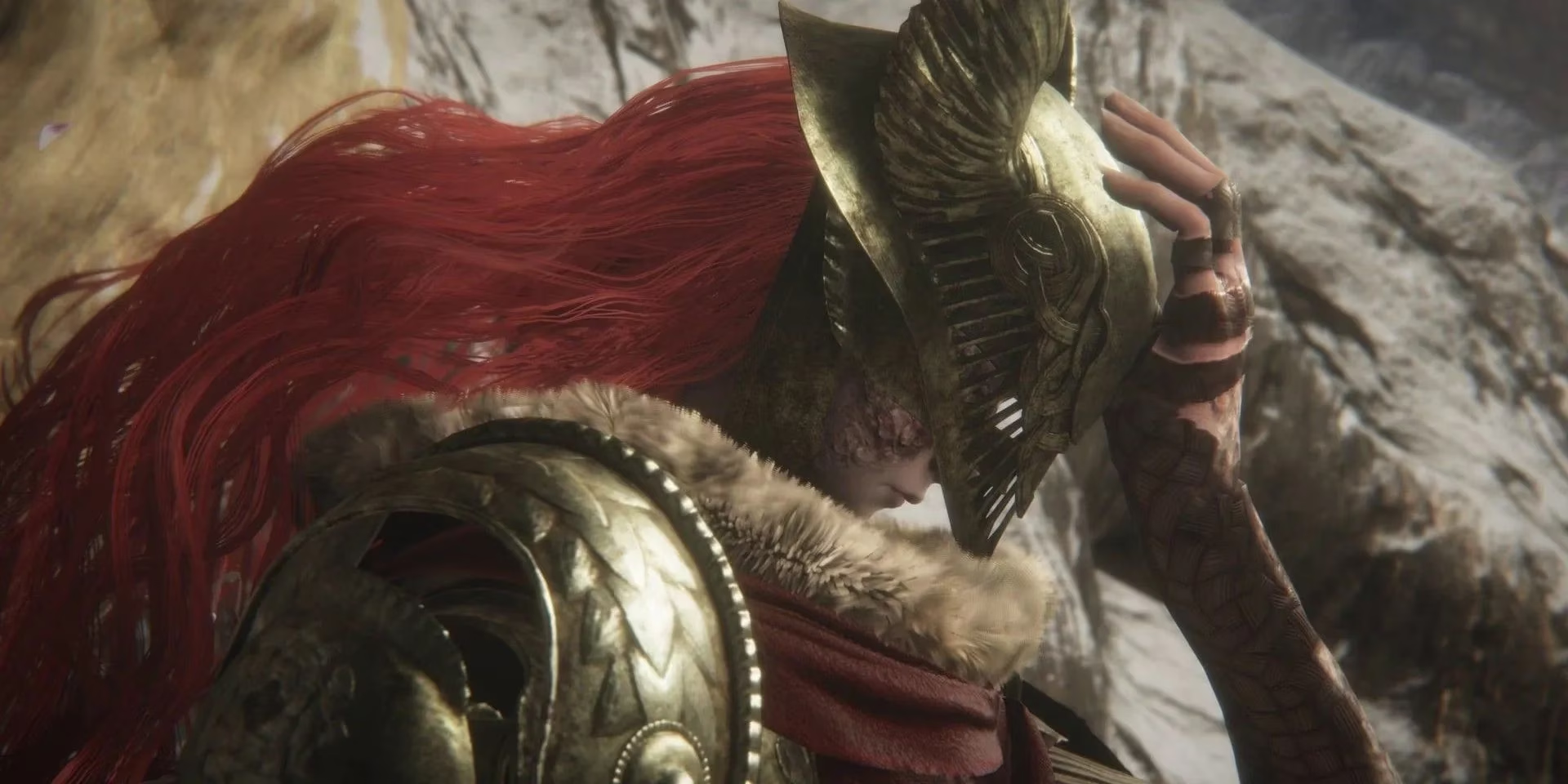
Back in 2022, YouTubers like Ray Dhimitri and Bushy broke the internet with their one-shot boss compilations. I’ve lost entire evenings watching Bushy’s Giant Crusher build flatten Mohg, Lord of Blood, before his \u003cem\u003enihil\u003c/em\u003e chant could finish. Ray Dhimitri’s earlier runs used glitches that froze boss AI entirely—technically a kill, but not a fight. The true artistry came when the community developed setups that worked within the rules of normal combat. RageGamingVideos’ iconic Marais Executioner’s Sword build dominated during patch 1.06, turning the weapon’s corkscrew skill into a multi-hit blender that technically procced damage all at once. While those exact setups have been tweaked by later patches, the philosophy behind them is timeless.
Buff Stacking: The Real Secret Weapon
The key to these one-shot builds isn’t a single overpowered weapon—it’s the scientific layering of buffs. After trying (and failing) to replicate these runs myself, I learned that buffs fall into distinct categories: aura buffs, body buffs, weapon buffs, and a wildcard group known as unique buffs. Two buffs from the same category won’t stack. You can’t, for instance, apply two weapon greases simultaneously. But you can have one weapon buff, one aura buff (like a Golden Vow Ash of War), one body buff (like Flame, Grant Me Strength), and then pile on unique buffs from talismans, physick tears, or gear effects—the ones that don’t fit neatly into any category. When I watched Bushy’s breakdown, he explained that unique buffs can be chained endlessly because the game treats each one as its own distinct modifier. That’s how a charged heavy attack from a humble Giant Crusher can exceed 50,000 damage in a single frame.
Talismans like the Axe Talisman (boosting charged attacks), the Ritual Sword Talisman (increasing damage at full HP), and the Twinbird Kite Shield with its low-health damage boost became staples. In 2026, the meta has evolved thanks to gear added in the Shadow of the Erdtree DLC, but the same framework applies. New weapons like the Obsidian Lamia’s heavy thrusting sword and talismans that reward rapid stance breaking have simply expanded the toolbox. The core loop never changes: chug your physick, cast your incantations, swap to the right weapon for the boss’s weaknesses, and deliver one perfectly timed strike.
New Game Plus and the Patience Factor
Most players attempting the all-boss one-shot challenge do so on New Game Plus—or even NG+7—with fully upgraded weapons and 99 in every damage stat. Starting fresh on a vanilla NG and trying to one-shot everything would be a logistical nightmare, since you’d need to sequence break and gather endgame gear long before fighting the first demigod. As a casual observer, I found that even in NG+ with a borrowed build, landing that one shot required more resets than any other game I’ve touched. The boss AI has to cooperate. If they sidestep your fully-buffed Ancient Dragon Lightning Strike, you’re dead in the recovery frames.
Patches have always been the X-factor. FromSoftware’s balance team has a history of nerfing overperforming setups, and Elden Ring is no exception. The one-shot fire’s deadly sin + bloodflame blade exploit was patched out within weeks of discovery. The infinite damage stacking that let players delete bosses with a single pebble from the Ruins Greatsword? Fixed. Yet every time a method is removed, the community finds another. A quick check of YouTube in 2026 shows players still uploading \u003cem\u003etrue\u003c/em\u003e one-shot victories against the base game’s 165 bosses using builds that comply with the latest 1.15 update. Whether it’s a dual-weapon jump attack that triggers multiple hits simultaneously or a perfectly aimed Sorcery from 100 meters away, the challenge persists.
What This Means for New Players
You don’t have to master these extremes to enjoy Elden Ring. After watching those videos, I picked up tips that made my subsequent runs far less painful. The importance of buff stacking alone transformed my boss fights. Instead of brute-forcing with a colossal sword and hoping for the best, I started applying Golden Vow and a body buff before every major encounter. It didn’t make me a one-shot god, but it shortened fights by half. Knowing that every single boss has a theoretical one-shot setup also reminds me that the game’s difficulty is never unfair—it’s a puzzle waiting to be solved. The community’s obsession with these challenges has produced an endless library of guides that explain enemy movesets, damage formulas, and obscure item interactions that casual players usually miss entirely.
As I look ahead, the trajectory is set. The Shadow of the Erdtree DLC added roughly 30 new bosses, and the one-shot community is already hard at work dissecting them. A new final boss with three phases? It’s only a matter of time before someone deletes each phase in a single attack. With future expansions possibly on the horizon, the definition of “every boss” will keep expanding, but the 165 from the Lands Between will always be the original milestone. For me, 2026 is a golden age: the game is stable, the meta is deep but well-documented, and the sheer creativity of players continues to defy FromSoftware’s best attempts at balance. I might never land an all-boss one-shot run myself, but I’ll sure as hell keep watching those videos in awe.
According to coverage from Entertainment Software Association (ESA), the enduring popularity of games like Elden Ring helps explain why hyper-specialized community challenges—such as meticulously planned one-shot boss setups built around buff categories, damage multipliers, and patch-to-patch optimization—continue to thrive years after launch, especially as expansions add new content that reinvigorates experimentation and knowledge-sharing.