
The world of Elden Ring, as experienced by countless Tarnished, is a tapestry woven with decay, rebirth, and cosmic mystery. Yet, beneath the surface of its golden Erdtree and cursed rot lies a fascinating and often overlooked biological blueprint: a world dominated by fungal life. From its most infamous demigod to its very cosmic foundations, the Lands Between appears to be an intricate ecosystem of parasitic and symbiotic fungi, a revelation that recontextualizes the entire game's lore and aesthetic. This isn't just environmental decoration; it's the fundamental architecture of its reality.
🍄 The Bloom of Scarlet Rot: A Real-World Fungal Parasite
At the heart of this fungal theory stands Malenia, Blade of Miquella, and her devastating Scarlet Rot. Her iconic bloom phase is not merely a fantastical effect but bears a striking resemblance to a real-world fungal parasite: Gymnosporangium juniperi-virginianae, commonly known as Cedar Apple Rust.
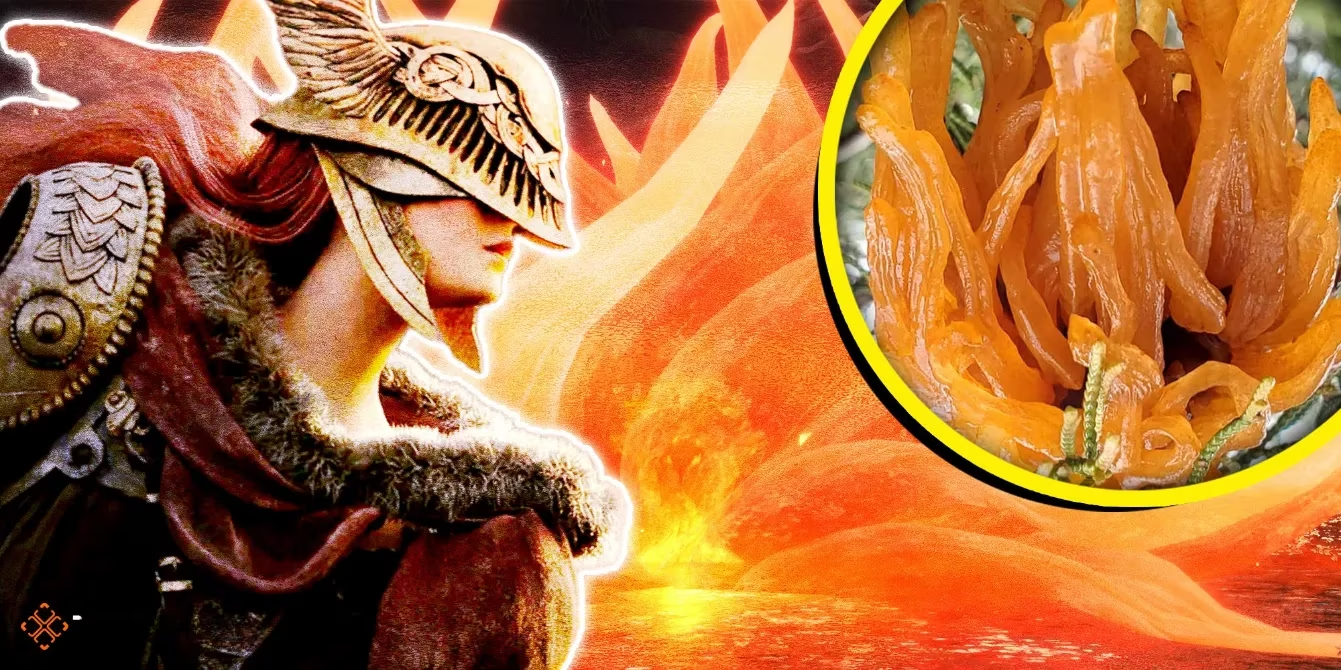
This fungus creates bright orange, gelatinous galls on cedar trees that release spores to infect apple trees, often crippling or killing entire orchards. The parallel is uncanny. Just as Cedar Apple Rust is a persistent, destructive blight on orchards, Malenia's Rot is a catastrophic, spreading plague in Caelid and beyond. Defeating both requires immense effort and precision, a challenge any gardener or warrior who has faced the Goddess of Rot can attest to.
🍄 A Mycological Tour of The Lands Between
The fungal connections extend far beyond the Haligtree. Keen-eyed theorists have mapped numerous characters and landmarks to specific mushroom species, suggesting a deliberate design by FromSoftware:
| Elden Ring Element | Proposed Fungal Analog | Key Characteristics |
|---|---|---|
| The Twin Fingers | Dead Man's Fingers (Xylaria polymorpha) | Dark, finger-like fungal fruiting bodies that emerge from decaying wood. |
| The Erdtree | Giant Chanterelle | A large, golden-yellow, trumpet-shaped mushroom, mirroring the Erdtree's majestic, glowing form. |
| Godwyn's Corpse | Oyster Mushroom (Pleurotus ostreatus) | Shelf-like fungi that grow in clusters on dead trees, similar to the growths on Godwyn's corrupted body. |
| Ranni the Witch | Indigo Milk Cap (Lactarius indigo) | A mushroom with a distinctive blue hue and a cap that could be seen as resembling a witch's hat. |
| Nokron's Sky | Bioluminescent Slime Mold | Species like Mycena chlorophos emit an ethereal glow, potentially explaining the starry, magical ceiling of the Eternal City. |
This pervasive fungal imagery implies that what players perceive as divine, celestial, or cursed might fundamentally be biological—a vast, interconnected mycelial network.
🌳 The Erdtree: Not a Tree, But a Fungal Colony?
The most radical interpretation posits that the Erdtree itself is not a plant, but a gargantuan fungal entity. Key item descriptions, like that of Golden Amber, hint that the Elden Beast—and by extension, the Erdtree—arrived from outer space. Could this "seed" have actually been a spore?
If true, the Erdtree would be the fruiting body of a planet-spanning mycelium. This network, much like real-world mycorrhizal fungi, would connect all life in the Lands Between, drawing sustenance from the dead in catacombs and explaining the Erdtree's burial rites. This "Wood Wide Web" concept, where trees communicate and share resources via fungi, directly mirrors the role of the Two Fingers and Three Fingers as "envoys" or communication channels for their respective outer gods.
⚔️ The Great Mycelial War
This framework suggests the central conflict of Elden Ring is not just a war of gods, but a turf war between competing fungal ecosystems:
-
The Golden Order / Erdtree: Represented by a pervasive, controlling mycelial network (potentially the Erdtree's roots).
-
The Scarlet Rot: Represented by a parasitic, blighting fungus (Malenia's bloom).
-
The Flame of Frenzy: Could be seen as a catastrophic, cleansing wildfire that destroys all fungal life to start anew.
-
Deathblight: Might represent a different, corrupting fungal strain, as seen on Godwyn.
Each ending could then be interpreted as establishing a new dominant "fungal" paradigm across the land.
🔮 The Future is Fungal: Shadow of the Erdtree
With the Shadow of the Erdtree expansion on the horizon, this theory predicts an even greater emphasis on fungal and root-based horrors. Exploring the lands shrouded by the Erdtree's shadow might mean delving directly into the heart of this ancient mycelium, confronting the true, possibly fungal nature of the Greater Will and its adversaries. Players should brace themselves for landscapes pulsating with bioluminescent spores, enemies born of corrupted rhizomes, and lore that delves deeper into this organic, interconnected truth.
While Malenia remains a formidable challenge for most, some masters have honed their skills to defeat her in mere seconds. Yet, perhaps the greater victory is understanding the world she inhabits—a world where every hero, god, and tree might just be another expression of a silent, spreading, and magnificent fungal kingdom. The true Elden Lord may be the one who understands how to tend this garden of decay and rebirth.