
In the realm of open-world gaming, the most immersive experiences often whisper their stories rather than shout them. While cinematic cutscenes and direct dialogue have their place, a growing number of developers are mastering the art of environmental storytelling—a technique that weaves narrative, lore, and history directly into the fabric of the world itself. This approach transforms exploration from a simple search for loot into a deeply personal act of archaeological discovery, where every ruined building, abandoned note, and silent vista holds a potential clue to a larger, often tragic, tale. Isn't it more rewarding to uncover a civilization's downfall by piecing together the scattered remnants of its existence than by being directly told what happened?
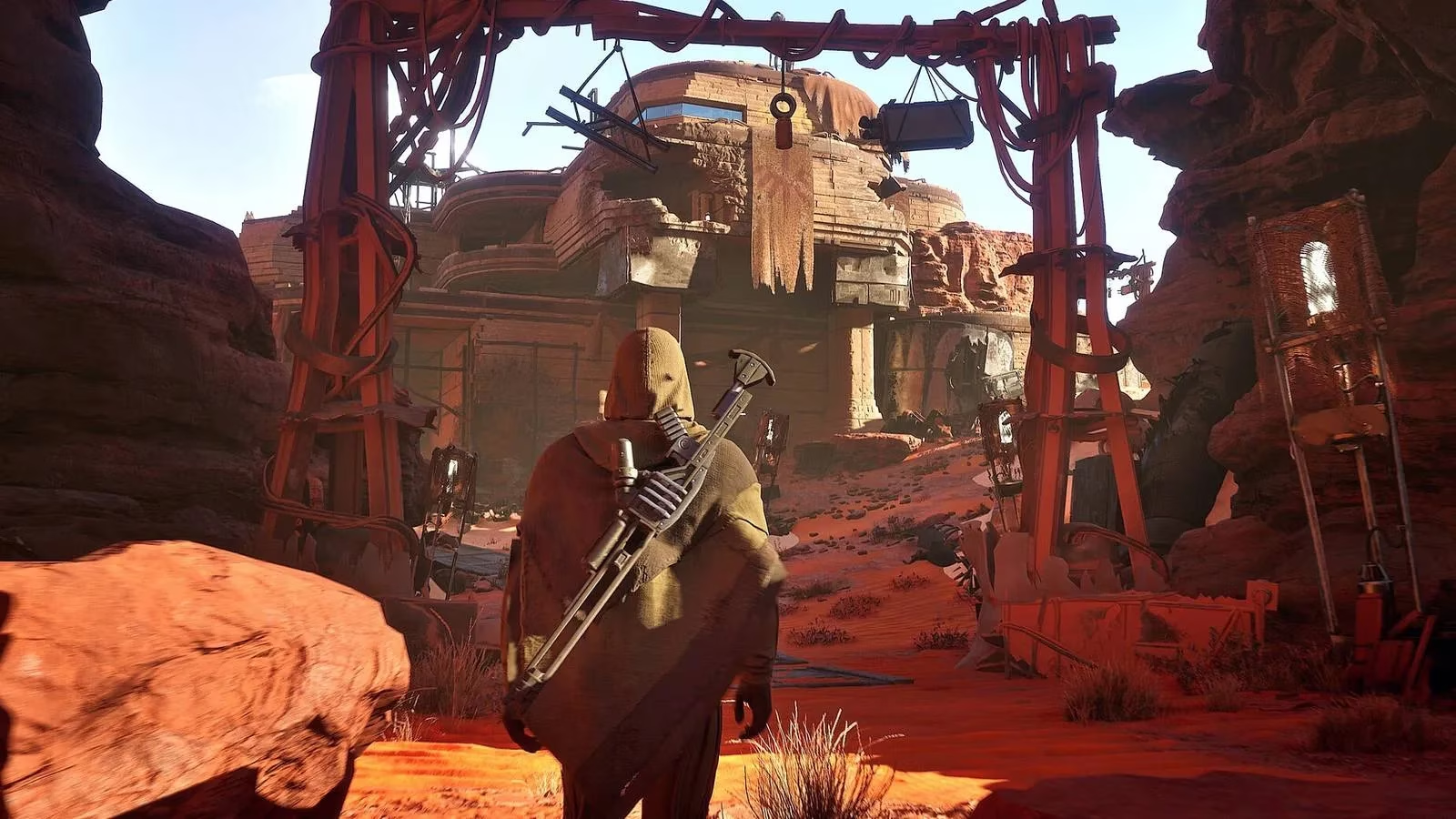
While FromSoftware's Elden Ring is frequently lauded as a pinnacle of this subtle craft, coupling immense freedom with a world dense in implicit lore, it is far from alone. The true magic of environmental storytelling lies in its ability to make the player an active participant in the narrative, rewarding curiosity and observation. Several other open-world titles have not only matched but in some aspects refined this delicate art, proving that a world can be its own most compelling narrator.
🏜️ Red Dead Redemption 2: The Living, Breathing West
Even years after its release, Red Dead Redemption 2 by Rockstar Games stands as a benchmark for a believable, reactive world. It masterfully employs environmental storytelling to create a sense of history and consequence that extends far beyond the main campaign of Arthur Morgan.
-
Subtle World-Building: From a lone, weather-beaten grave on a hilltop to the slowly decaying carcass of a hunted animal, the world is filled with silent vignettes. Distant cabins hide stories of desperation or madness, told through the placement of objects, bloodstains, and hastily written letters.
-
Balanced Approach: Unlike the opaque mysteries of Elden Ring, RDR2 strikes a perfect balance. It provides enough context through its traditional narrative to ground the player, while leaving countless environmental stories optional and open to interpretation. This allows players to choose their level of engagement, from following the main story to becoming a true historian of the American frontier.
🌃 Cyberpunk 2077: Secrets of the Sprawl
The neon-drenched dystopia of Cyberpunk 2077's Night City is a character in itself. CD Projekt Red has filled every alleyway, megabuilding, and corpo plaza with implicit stories that reflect the city's cutthroat nature and layered history.
| Environmental Story Element | What It Reveals |
|---|---|
| Abandoned Apartments | Eviction notices, personal belongings, and signs of struggle paint a picture of the city's housing crisis and economic disparity. |
| Corporate Rooftops | Opulent, sterile spaces with hidden security logs and data shards hint at boardroom betrayals and illegal experiments. |
| Back-Alley Scenes | Evidence of gang rituals, failed deals, or scavenger activity shows the underbelly of city life that the main quests often bypass. |
Post-launch updates have only deepened this aspect, adding more hidden stories and making the city feel more alive than ever. The environmental clues encourage players to look beyond the quest marker and truly listen to what the city is saying.
☢️ STALKER 2: Heart of Chornobyl: Whispers from the Zone
GSC Game World's STALKER 2 builds upon the legendary atmosphere of its predecessors, creating an open world where danger and mystery are baked into every irradiated corner. The Zone is not just a setting; it is the primary antagonist and storyteller.
-
Micro-Stories in the Macro-World: Every hidden stash has a former owner, whose fate can often be deduced from the items left behind and the surrounding hazards. Each abandoned research lab tells a story of scientific hubris and catastrophic failure through scattered notes, mutated specimens, and malfunctioning equipment.
-
Anomalous Storytelling: The Zone's deadly anomalies and artifacts aren't just gameplay obstacles; they are environmental narratives. Their placement and behavior hint at the physics-breaking events of the past, encouraging players to learn the "rules" of this twisted reality to survive and understand.
🏜️ Dune: Awakening: The Desert as a Document
Funcom's Dune: Awakening takes a radically minimalist approach, placing the planet Arrakis itself at the center of the narrative. In this survival MMO, the environment isn't just a backdrop—it's the main plot.
The game's philosophy is clear: the story of Arrakis is written in its dunes, its rock formations, and its silent, ancient ruins.
Players must become readers of the desert. A wrecked spice harvester half-buried in sand tells a tale of mechanical failure and a desperate, likely fatal, struggle for survival. Abandoned ecological testing stations, with their decaying equipment and fragmented logs, reveal the failed attempts to tame the planet. Here, the classic "show, don't tell" rule is paramount, as the lack of exposition forces a deeper, more intuitive connection with the world.
🏛️ The Division 2: Scenes from a Collapse
Massive Entertainment's The Division 2 presents one of the most visceral examples of environmental storytelling in a modern setting. The game transforms a meticulously recreated Washington, D.C., into a museum of societal collapse, with each exhibit telling a silent, heartbreaking story.
-
Domestic Snapshots: Apartments frozen in time—a set table for a dinner that never happened, a child's toys abandoned mid-play, a barricaded door from the inside—create an intimate sense of loss.
-
Institutional Decay: Government buildings, museums, and shopping malls show the rapid descent from order to chaos, with makeshift shelters, warning signs, and the inevitable presence of the dead.
-
Audio-Visual Cues: The environmental narrative is amplified by discoverable echoes of the past: lost cell phone messages, emergency broadcasts, and security camera footage that players can stumble upon, piecing together the final days before the fall.
️ The Legend of Zelda: Breath of the Wild: The Poetry of Ruins
Nintendo's masterpiece, The Legend of Zelda: Breath of the Wild, uses silence and space as its primary narrative tools. The vast, post-calamity Hyrule is a land where history is etched into the geography itself.
-
Architectural Archaeology: Scattered ruins of guardians, overgrown temples, and the haunting remains of villages like Mabe Village tell the story of a prosperous kingdom brought low. The placement of these ruins relative to Hyrule Castle visually narrates the spread of Ganon's devastation.
-
Environmental Cause and Effect: The game's physics and chemistry systems become part of the storytelling. Why is this forest burnt? A lightning strike. Why is this path blocked? A landslide caused by rain. The world feels like it has a past that logically informs its present state, rewarding players who think like detectives.
️ Fallout 4: Curated Catastrophe
A Bethesda game is synonymous with world-building, and Fallout 4 continues this tradition with a meticulously handcrafted Commonwealth. Every location, no matter how small, feels deliberately designed to tell a micro-story.
🔍 Examples of Environmental Narratives in the Commonwealth:
-
Skeleton Scenes: Perhaps Bethesda's signature technique. A skeleton posed at a dinner table with poison, two skeletons embracing in a closet, a skeleton in a bathtub with a toaster—each is a darkly humorous or tragic punchline to a lost life.
-
Terminal Lore: Computer terminals in ruined offices, military bunkers, and homes provide the "why" behind the environmental "what," connecting personal stories to the larger catastrophe.
-
Faction Footprints: The environmental changes brought by different factions (The Institute's synths, the Brotherhood's vertibirds, raider camp decorations) show a world in active, contested evolution, not a static ruin.
In conclusion, while Elden Ring rightfully receives acclaim for its opaque and rewarding environmental lore, it exists within a rich ecosystem of games that have mastered this subtle art. From the cinematic realism of Red Dead Redemption 2 to the minimalist desolation of Dune: Awakening, these titles prove that the most powerful stories are often those we discover for ourselves, written not in words, but in the silent language of a world waiting to be understood. They challenge the player to move beyond being a mere consumer of narrative and become an active explorer, historian, and interpreter. In 2025, this remains one of the most powerful and immersive trends in open-world design.